 Vietnamese
 English

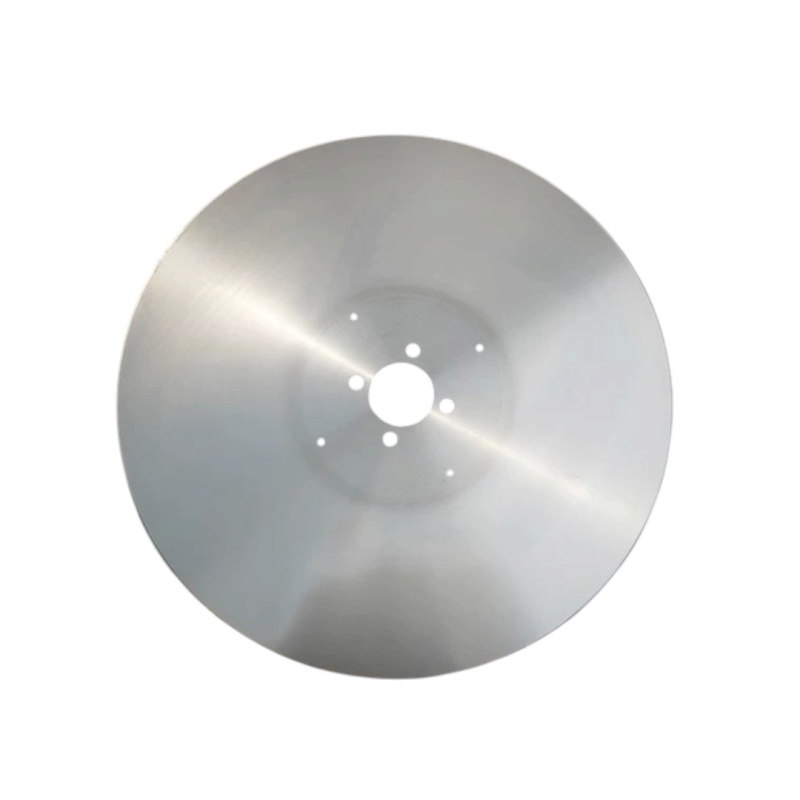
Logsaw Ø610mm Rotary Cutting Circular Blade for Tissue
Product Details
What is a large rotary cutting circular blade?
A large rotary cutting circular blade is a large-diameter disc knife — most commonly Ø610 mm — fitted to the rotary cutting head of tissue paper cutting machines, facial and cotton towel cutters, and high-speed unwinding lines.
Unlike small-diameter slitting knives that only trim edges, the rotary blade is the finishing cut: it severs the full log or the full running web width. A poor cut here goes straight into the finished product — fuzzy edges, parallel score marks, or blackened edges — and no downstream operation can fix it.
Reading the specification: what does 610 × 68 × 4.76 (3.5) mean?
| Figure | Meaning | Practical note |
|---|---|---|
| 610 | Outer diameter (OD) | Exactly 24 inches. The clearest sign this blade family originates from imperial-dimensioned imported machinery. |
| 68 | Inner bore diameter (ID) | The same family is also sold as 68.26 and 68.27 mm — that is 2-11/16 inches. Always measure with a caliper; never assume. |
| 4.76 | Body thickness | Exactly 3/16 inch. The same Ø610×68 is also available in 3.8 mm and 3.5 mm bodies. |
| (3.5) | Alternative thickness, or the ground-down rim zone | Measure at two points: next to the hub and next to the cutting rim. Different readings mean the blade is hollow ground or double bevelled. |
Beyond the three basic dimensions, two more details decide whether the blade will actually mount: the number of bolt holes and their pitch circle diameter (PCD), and the bevel configuration (single or double bevel, and the included angle). Without these, a blade of the correct diameter still will not fit.
Where these blades are used in a tissue mill
- Rotary cutting machines for toilet tissue, facial tissue and cotton towels — single or twin channel.
- High-speed unwinding stations on imported tissue converting lines.
- Core cutting and paper tube unwinding — same disc format, different material and bevel angle.
- Disc cutters (盘切刀) on tissue machines — the Ø610 × 68.26 × 4.76 mm configuration has been supplied to Andritz and Valmet tissue machines at several major Chinese tissue producers.
Some mills use an alternative arrangement: knife rings with carbide inserted on one or both faces, paired with a high-speed steel upper circular knife, on imported high-speed rewinder-slitters. This configuration offers strong wear resistance and a longer interval between regrinds.
The main problem with large-diameter disc blades: run-out
A Ø610 mm steel disc only 3.5–4.76 mm thick has a diameter-to-thickness ratio above 125. A disc this slender warps easily, and at operating speed a few hundredths of a millimetre of error at the hub is amplified into significant deflection at the cutting rim.
The direct consequence is a cut face carrying several parallel score lines — operators call this "multi-knife marking" (多刀纹): one cut leaving several blade traces. Serious manufacturers address it by grinding on imported ultra-precision machines to control concentricity and face parallelism, so the edge does not wobble once mounted.
When buying a Ø610 blade, ask about four figures beyond the dimensions:
- Concentricity between the bore and the cutting rim.
- Parallelism of the two faces and overall flatness.
- Axial run-out when mounted on a reference flange.
- Thickness consistency around the circumference.
For tissue-industry tooling, manufacturing tolerances can reach the micron level, and on perforating fly knives parallelism is typically held within about 0.01 mm so the perforation line opens evenly.
Blade materials
| Group | Common grades | Characteristics | Best suited to |
|---|---|---|---|
| Alloy tool steel | 9CrSi, Cr12MoV, SKD-11 / D2 | Reasonable cost, tough, easy to regrind. Moderate wear resistance. | Domestic machines, medium speed and volume |
| High-speed steel | W6Mo5Cr4V2, W18Cr4V, M2 / SKH51 | Noticeably longer edge life, better hot hardness at speed. | Imported high-speed lines |
| Imported tool steel | DIN 1.3343, DIN 1.2888 | Consistent microstructure, suited to tight precision requirements. | Lines demanding a flawless cut face |
| Cemented carbide | Single or double-face carbide-inserted knife rings | Longest life and longest regrind interval; highest investment. | High-speed rewinder-slitters |
A requirement specific to tissue: no product contamination
Toilet tissue and facial tissue are hygiene products in direct contact with the user, so the blade must be rust resistant as well as sharp. A corroded blade leaves dark streaks on the roll edge and the whole batch fails on appearance. This is why suppliers in this segment emphasise corrosion resistance and the classic three-point appearance standard: no fuzzy edge, no saw marks, no blackening.
Troubleshooting table
| Symptom | Most likely cause | Action |
|---|---|---|
| Several parallel score lines on the cut face | Blade run-out from off-centre mounting, dirty flange, or a warped disc | Remove, clean the flange faces, check run-out with a dial indicator before final torque |
| Fuzzy, fibrous roll edge | Dull edge, bevel gone blunt | Regrind to the original angle; never hand grind |
| Blackened roll edge | Corroded blade, or excessive cutting heat from a dull edge | Replace the blade; review material grade and storage conditions |
| Saw-tooth appearance on the cut | Uneven grinding or an unsuitable grinding wheel | Use the wheel specified by the blade manufacturer |
| Abnormal vibration and noise in operation | Dynamic imbalance, or insufficient flange clamping force | Torque bolts in a symmetrical sequence; rebalance the assembly |
| Blade wearing on one side only | Shaft not square to the web travel direction | Realign the cutting unit — this is a machine fault, not a blade fault |
Regrinding and storage
- Grind on a dedicated machine. Large disc blades must be reground on a disc-blade grinder to preserve concentricity; hand grinding will destroy the profile.
- Use the correct grinding wheel. Tissue-blade manufacturers usually supply a wheel matched to the blade material — using an arbitrary wheel is a common cause of saw marks on the roll edge.
- Record the diameter after each regrind. Once a Ø610 blade reaches its minimum diameter it must be scrapped, since rim speed and cutting force change.
- Store flat or hanging vertically. Never lean a Ø610 disc against a wall — it will warp under its own weight within weeks.
- Protect against corrosion. Apply preservative oil and wrap in moisture-barrier paper. In humid climates an unprotected blade can start rusting at the rim within days.
- Buy in pairs or sets. Keeping a reground spare turns a blade change into a few minutes instead of a machine stop waiting for grinding.
DTS – BladeX supplies large circular blades for the tissue industry
DTS imports and distributes industrial blades for the paper and packaging industry in Vietnam, including the large-diameter disc blade range:
- Rotary cutting circular blades Ø610 × 68 × 4.76 mm, also in 3.8 and 3.5 mm bodies.
- Bore sizes 68 / 68.26 / 68.27 mm to match imported machinery.
- Materials to order: 9CrSi, Cr12MoV, SKD-11, high-speed steel W6Mo5Cr4V2, and imported tool steels.
- Non-standard large discs made to sample or drawing — including larger formats such as Ø800 × 68 × 5 mm.
- Companion tooling for tissue lines: trim slitting knives, perforating anvil and fly knives, and core cutting blades.
Send us a photo of the worn blade next to a ruler, or the OD × ID × thickness together with the bolt hole pattern and bevel type. We will return a quotation and lead time within 24 working hours.
Frequently asked questions
Is my bore 68 mm or 68.26 mm?
Measure it — do not guess. The Ø610 family exists in 68, 68.26 and 68.27 mm because the specification originates in inches. A 0.26 mm gap is enough to let the blade sit loose on the shaft and run out.
Can I replace a 4.76 mm blade with a 3.5 mm one to reduce mass?
Not as a casual substitution. Thickness governs disc rigidity and kerf width. A thinner blade warps more easily and deflects when cutting thick logs. Change only if the machine builder or the blade supplier confirms the configuration.
Is high-speed steel worth the extra cost?
Yes, if you run an imported high-speed line and cost the blade per finished roll rather than per piece. The real cost of a blade sits in downtime for changes and regrinds, plus the paper wasted once the edge starts to dull.
How often should the blade be reground?
There is no universal figure — it depends on basis weight, line speed, number of plies and blade material. The correct approach is to monitor the cut edge appearance and log the number of rolls run between regrinds, building a norm specific to your mill.
 0978039932
 0978039932
 Messenger
 Youtube