 Vietnamese
 English

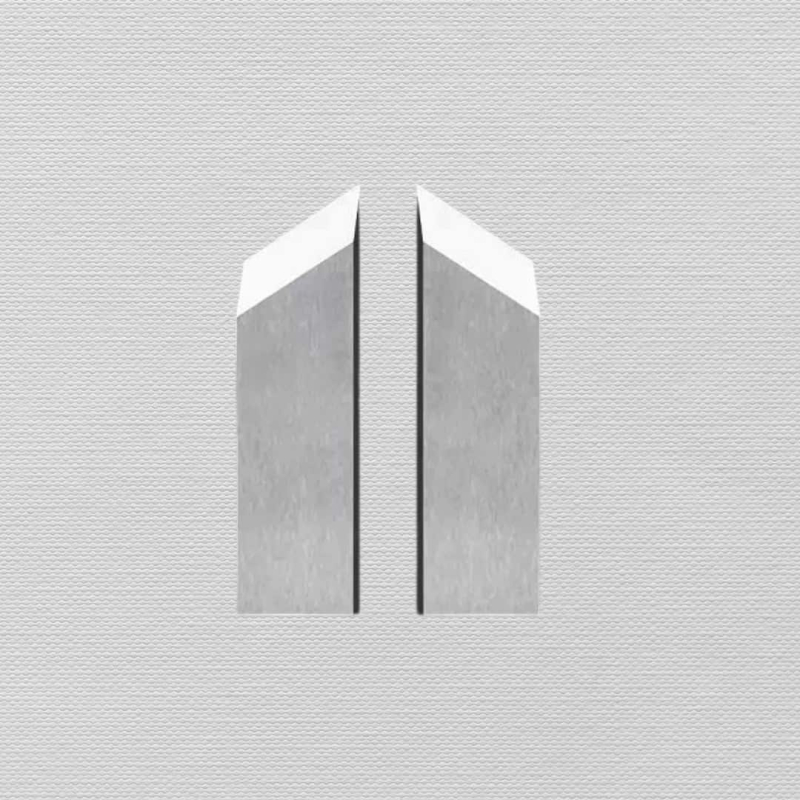
Carbide V-Groove Blades for Rigid Gift Boxes
Product Details
What is a carbide V-groove blade for rigid boxes?
A carbide V-groove blade for rigid paper boxes (also called a V-cut blade or V-grooving machine knife) is a tool used on V-grooving machines to mill a V-shaped channel into a sheet of rigid board, so the board can be folded to square and formed into the body of a gift box, a lid-and-base box, or a premium display box.
One distinction matters from the outset: this is not the slotter knife used on corrugated printer-slotters for 3-ply and 5-ply shipping cartons. A corrugated box uses a pair of rotating disc knives to shear the walls open and create the flaps. A rigid box instead has a V-shaped channel milled out of solid board (grey board), leaving only a thin skin of paper to act as a hinge. The two processes are entirely different, and so are the blade material and edge geometry.
Where V-grooving sits in the rigid box process
A premium gift box passes through these core stages:
- Board cutting — trim the grey board to the flat development size of the box.
- V-grooving (V-cut) — mill a V channel along each fold line.
- Folding and corner taping — fold along the grooves and tape or glue the corners to form the box shell.
- Wrapping — laminate printed art paper, specialty paper, velvet or leather onto the surface to finish the box.
Grooving is the step that determines the shape of the box. The V channel must be milled accurately so that, once folded, the outside edge is straight, the inside corner is square, and all four corners meet with no gap. A groove cut at the wrong angle or the wrong depth produces bowed panels, open corners and bulging faces — faults no later operation can correct, which means scrapping the whole batch of board.
The three process parameters that define the groove
Three figures determine groove quality, and they are also the three figures used to specify the blade.
1. Board thickness
Grey board for gift boxes typically runs from 1 mm to 4 mm, with 1.5–3 mm being most common. The thicker the board, the wider the groove, the higher the cutting load, and the faster the blade dulls.
2. Groove angle
The standard angles are 90° for square and rectangular boxes and 120° for hexagonal boxes. For special constructions — octagonal, chamfered or angled boxes — the groove angle is calculated to match the intended fold angle. The blade angle must match the groove being cut, which is why V-cut blades are always ordered by angle.
3. Remaining connecting layer
This is the subtlest parameter. The blade must not mill through the full board thickness; roughly 0.25 mm of paper is left at the bottom of the groove to serve as the hinge. Leave too much and the board will not fold square, giving a rounded edge; leave too little, or cut through, and the board snaps apart during folding and the blank is scrapped. A dull or chipped blade is the number one reason this residual layer becomes uneven along the groove.
Types of V-groove blade on the market
Insert blades mounted in a cutter head (the most common type)
A rectangular insert with a V bevel ground on one edge, bolted into the cutter head (刀座) of the grooving machine. A very common replacement size on lid-and-base box machines is 52 × 19 mm. Advantages: low cost, quick to change, and regrindable several times while enough edge height remains.
Solid V-profile milling cutters
A circular milling cutter with a V profile, mounted on the spindle. Used on high-speed grooving machines and CNC equipment. Profile stability is better and the groove surface is smoother, but the tool costs more and must be reground on dedicated equipment.
Manual and sampling machine blades
Benchtop V-cut machines serve sample rooms and short runs, operating entirely mechanically with no power supply. These machines also use tungsten carbide edges so the tool does not rust and holds its sharpness, and they deliver several times the output of scoring by hand with a utility knife.
Multi-spindle machines
Four-spindle and six-spindle grooving machines mill several parallel grooves in a single pass. A six-head machine can produce up to eight grooves in one pass of the blank, serving hexagonal and octagonal box styles rather than four-cornered boxes only. On multi-spindle machines, it becomes mandatory that every blade in the set matches in angle and edge height — a single blade out of tolerance leaves the whole sheet with uneven grooves.
Blade material: tool steel, high-speed steel or carbide?
The grades commonly offered for grooving and paper-industry blades include H13, SKD-11, D2, Cr12MoV, 6CrW2Si, 9CrSi and the YG carbide group. Machining tolerance on precision blades can reach ±0.002 mm.
| Material group | Typical grades | Hardness | Behaviour when grooving board |
|---|---|---|---|
| Alloy tool steel | SKD-11 / D2 / Cr12MoV | 58–62 HRC | Tough, chip resistant, low cost, easy to regrind. Wears quickly on recycled board with high ash content. |
| High-speed steel | W6Mo5Cr4V2 / SKH51 | 62–65 HRC | Sharp, holds an edge reasonably well, balanced on cost and life. The mainstream choice. |
| Cemented carbide (tungsten carbide) | YG6 / YG8 / YG15, fine grain | 86–93 HRA | Hardest, longest edge life, smooth groove face, no burring. More brittle; needs accurate mounting and diamond wheels for regrinding. |
Why a carbide edge earns its price on gift box work
Cemented carbide reaches 86–93 HRA (roughly 69–81 HRC), second only to diamond, and retains hardness at elevated temperature. On V-cut tooling, solid carbide edges are reported to last tens of times longer than ordinary tool steel blades, which sharply reduces the number of stoppages for blade changes and regrinding.
This matters especially with grey board. Grey board is made from recycled fibre and contains mineral filler, kaolin, adhesive and contaminants — an aggressively abrasive mix that consumes an edge far faster than cutting virgin white paper. For a plant running two shifts, the true cost of a blade is not its purchase price but the number of machine stops and the volume of board scrapped because the edge went dull.
How to specify the right V-groove blade for your machine
When ordering, supply the following:
- Blade dimensions: length × width × thickness (for example 52 × 19 × 2 mm). Measure the old blade with a caliper rather than trusting the machine catalogue.
- Edge angle: 90°, 120° or a special angle.
- Bolt hole position and diameter, and whether the holes are countersunk.
- Bevel orientation: single or double bevel, left hand or right hand.
- Board type and thickness currently in production, plus output per shift.
- Machine make: Long Xing Jian, Jin Jun, other common Chinese V-cut models, or locally built equipment.
The safest approach is to send a photo of the used blade laid next to a ruler, or simply ship one sample blade. For non-standard blades, a simple technical drawing stating the angle tolerance is enough to place a custom order.
Recognising a blade that needs replacing or regrinding
| Symptom on the product | Likely cause | Action |
|---|---|---|
| Groove bottom fibrous and fuzzy | Dull edge, nose radius gone blunt | Regrind or replace the blade |
| Board snaps apart at the groove when folded | Cut too deep, connecting layer below 0.25 mm | Reset depth, check blade mounting height |
| Folded edge is rounded, corner not square | Groove too shallow, or blade angle does not match the fold angle | Verify blade angle, increase depth in small increments |
| Four corners of the box do not meet | Spindles not matched in blade height | Realign the whole cutter head set; replace blades as a matched batch |
| Ridges in the groove, rough groove face | Chipped edge, or vibration from a loose mounting | Retighten the bolts, inspect the seating face of the holder |
| Machine labours, blank pushed backwards | Blade badly dulled, or board too damp | Change the blade, check board moisture |
Maintenance and extending blade life
- Replace as a set, not individually. On a multi-spindle machine, mixing old and new blades gives uneven grooves. Change the whole set together.
- Clear paper dust every shift. Grey board dust building up around the holder shifts the mounting position and raises cutting temperature.
- Inspect the holder seating face. A worn, dished holder will throw off the angle even with a brand new blade.
- Use the correct wheel. High-speed steel blades take conventional wheels; carbide requires a diamond wheel, ground dry or with consistent coolant, never letting the edge burn blue.
- Control board moisture. Board that is too dry generates burrs and fine dust; board that is too damp crushes easily and sticks to the edge.
- Keep a blade log. Record the number of blanks run between blade changes. After a few months you will have a real consumption norm for your own plant and can order to plan instead of ordering in a panic.
DTS – BladeX supplies V-groove blades for the rigid box industry
DTS imports and distributes industrial blades for the paper and packaging industry in Vietnam, including the V-grooving range for rigid box machinery:
- V-cut insert blades in common sizes, stocked in 90° and 120°.
- Materials to order: SKD-11 / Cr12MoV, high-speed steel W6Mo5Cr4V2, or tungsten carbide edges for high-output plants.
- Non-standard blades made to sample or drawing, including special groove angles for hexagonal, octagonal and chamfered boxes.
- Material selection advice based on your actual board type, thickness and production volume.
Send us a photo of the used blade next to a ruler, or the length × width × thickness together with the edge angle. We will return a quotation and lead time within 24 working hours.
Frequently asked questions
Can a corrugated slotter knife be used instead of a V-groove blade?
No. A corrugated slotter shears completely through the board to form the box flaps, while a V-groove blade removes a V-shaped channel and preserves the bottom paper layer as a hinge. The edge geometry, the mounting and the cutting motion are all different.
Should I choose 90° or 120°?
90° for square and rectangular boxes — that is most gift boxes and lid-and-base boxes. 120° is used where the panel must fold to an obtuse angle, typically on hexagonal boxes. For unusual constructions, the groove angle must be calculated from the fold angle in the design.
How many blanks will one blade cut?
There is no universal figure, because it depends on board thickness, recycled fibre content, mineral filler content and machine speed. The accurate method is to log the number of blanks between blade changes in your own plant. As a general rule, a carbide edge lasts many times longer than a tool steel edge under identical conditions.
Can carbide blades be reground?
Yes, but only on a diamond wheel using dedicated grinding equipment to preserve the exact angle. Hand grinding on a conventional stone will round the nose and destroy the V profile.
 0978039932
 0978039932
 Messenger
 Youtube